Continuous improvement with 5S as a foundation for future-proof maintenance
How VolkerWessels Materieel & Onderhoud got a grip on structure, safety and job satisfaction with continuous improvement and 5S
Within the VolkerWessels Group, VolkerWessels Materieel & Onderhoud (VWMO) fulfills an essential role. From the workshops in Neighbors and Dordrecht is working daily to manage, maintain and deploy an extensive and diverse range of equipment. Machinery that is crucial for the safe, efficient and reliable execution of infrastructure projects throughout the Netherlands.
That responsibility requires more than skill. It requires overview, predictability and processes that move with the organization. After a reorganization, in which both workshops came under one organization, a logical moment arose to reflect on the way of working. Both locations were functioning well, each with their own dynamics and strengths. At the same time, the realization grew that better coordination and more uniformity were needed in order to work smarter structurally and reduce waste in the processes.
When continuous improvement is no longer a choice
According to Remo Meijdam, VWMO's business manager, that very transition became the moment to take a critical look at existing ways of working. "We had a new organization, but were still largely working from existing routines," he says. "We have tremendous skill in house. People know what they are doing. At the same time, you want to prevent working methods from becoming too dependent on how things have always been done. We wanted to get sharp: are we doing the right things, and are we doing them in the most logical way?"
That observation was the starting point for a broader approach to continuous improvement (CI). Not a separate improvement project, but an integrated approach in which Lean techniques, Kaizen and 5S converge. The goal was clear: shorter lead times, higher efficiency and more calm in the workshop, without compromising safety or craftsmanship.
About VWMO
VWMO is an equipment company and part of KWS Infra. The organization specializes in managing and maintaining a comprehensive equipment package, including all associated electrical and mechanical installations for the construction and maintenance of infrastructure.
Understand current situation first
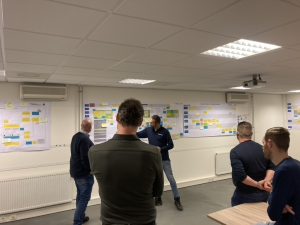
With two teams in Buren and Dordrecht, the current situation was mapped out together with the employees. Processes were analyzed, bottlenecks were identified and waste was made visible. Using the Kaizen method, points for improvement were identified and translated into clear action plans that were directly linked to daily practice.
Wessel Vuijk, project leader within VWMO, emphasizes the fact that it was precisely walking on the shop floor that was decisive. "You can describe processes, but you only get the real insights on the floor," he explains. "When you see where people have to improvise, where information is missing or where it's actually just too busy. Those conversations and observations were enormously valuable. With the support of CI Company was provided structure in the approach and guidance during the process. Not to delay, but to ensure that improvements were actually implemented and secured."
Not a first time, but a different approach
For VWMO, 5S was not unknown territory. It had been used in Dordrecht in the past, but the effect did not always prove lasting. Because of organizational changes and the pressure of daily operations, structure disappeared into the background after a while.
Precisely that insight made the difference this time. Not a new 5S trajectory on its own, but an approach in which 5S was explicitly linked to continuous improvement and the broader maintenance process. According to Dennis van de Bunt, co-owner of 5S Company, therein lies the core of the success. "5S did not become a goal in itself," he says, "but a practical tool to make structure and safety visible and manageable on the shop floor. Only then will it stick."
Both workshops were looked at separately, each from its own dynamics. These insights together formed the basis for a common vision of the future. No blueprint in which everything had to be exactly the same, but a clear direction: this is how we want to cooperate, this is how we guarantee safety and this is how we keep a grip on our work.
From analysis to action: 5S in practice
Within the CI project, a phased approach was deliberately chosen. The first full 5S rollout took place in Buren, where work is often unscheduled and equipment returns to the workshop at the end of the day. This was precisely where rapid, visible improvements were needed.
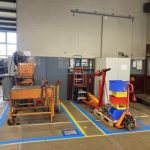
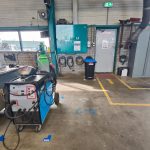
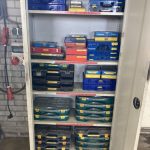
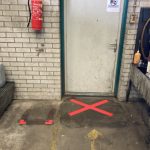
The workshop in Buren consists of several sub-areas, such as the warehouse, the Truck MOT lane and the construction and machining department. Therefore, the rollout was carried out step by step. All employees, including KAM, were trained and actively involved in the 5S scan. Then the first three S's of 5S were physically started: separate, clean and arrange. The entire team went through these steps together. The new layout was determined together and supported with clear lines, signs and visual agreements.
The warehouse was also included. Not from the idea of 'everything gone or everything in stock', but by looking per process what works practically. As Dennis puts it, "Not every Lean tool needs to be applied everywhere. It has to fit the work on the floor. Sometimes that means making very conscious choices in storage, inventory and working methods."
Dordrecht: deliberately slowing down to speed up
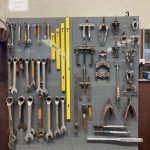
After the successful 5S rollout in Buren, it was the turn of the mechanical department in Dordrecht. This project required a different approach. There was deliberately more time than usual between theory, Gemba walk and roll-out. Not because things were at a standstill, but because major preparations were needed to make 5S a real success. Shelving was moved, the area for special tools was completely rearranged and even a complete machine was moved. Thanks to this thorough preparation by VWMO's team, the rollout immediately connected with practice and was widely supported on the shop floor.
What it delivers in daily practice
The effects soon became apparent. More overview, fixed places and clear agreements brought peace and predictability back into daily work. For Fred van Meteren, workshop manager in Buren, this is noticeable every day. "It just works nicer and faster. You have to search less and everything is where it belongs." Also Marc Campschreur, warehouse worker in Buren, sees the difference in his daily work. "It has become safer and quieter. I work daily using the app to make rounds and address colleagues. That helps maintain the level." External audits later confirmed what was already experienced internally: the foundation is solid and supported by the people on the floor.
Change management without embellishment
Change does not mean convincing everyone immediately. It requires space to get used to and experience results. This was also true in Dordrecht. Hugo Drost, foreman at this location, was honest about this: "My first thought was honestly: a waste of money. But when you saw what it yielded, that image quickly turned around."
According to Wessel Vuijk, the strength of the trajectory is not in the method, but in the way of working. "We didn't impose anything," he explains. "We looked at it together, made choices and stuck to them consistently. That makes it stick."
Standing firm and looking forward
After the rollout, the focus shifted to Standstill. Board meetings are held, 5S rounds run with support from the 5S app and areas for improvement remain visible. Not to control, but to stay sharp and make continuous improvement part of daily work.
The structure put in place creates room to look ahead. VWMO is working toward a more data-driven and predictable maintenance approach, in which maintenance history, running hours and supplier information are better recorded and linked. This helps with planning, budgeting and making future-oriented choices.
What ultimately matters
Looking back, the conversation is hardly ever about CI, Lean or 5S as methods. It's about overview, cooperation and job satisfaction. Remo sums it up succinctly: "It feels logical. People know why things are set up the way they are and take responsibility for it. For me, the biggest compliment is that people are now picking it up themselves." This change is not limited to one workplace. Cooperation between the locations has also changed noticeably. Wessel sees this every day: "It no longer feels like two separate workplaces. People know each other better and know how to find each other more easily."
The core of this trajectory is clear: no quick wins, but building step by step a way of working that fits the practice and prepares for the future. Thank you for your confidence, VolkerWessels Materieel & Onderhoud. Proud to realize tangible improvements together in Buren and Dordrecht and to lay a solid foundation for continuous improvement.