
5S Implementation at Paashuis Commercial Vehicles: From Skepticism to Ownership
“When other dealers or colleagues asked Roger what he thought of 5S before the 5S rollout, his answer was always the same: it's a significant investment.”
Jasper te Braak, the branch manager in Lichtenvoorde, laughs when he thinks back to it. That reaction from owner Roger Paashuis was genuine. When Volvo Trucks introduced the Lean for Retail program, Roger primarily saw a significant investment, a workshop that would be temporarily shut down, and lost revenue. Doubts also existed within the organization. Jasper te Braak, branch manager in Lichtenvoorde, and Carlo Scheerder, branch manager in Doetinchem, primarily saw the impact the process would have on daily operations.
The decision to start with 5S was ultimately postponed for almost a year. With an ongoing ISO process, sick leave, and a packed schedule, there was always a reason to wait a little longer. Nevertheless, both branches decided to take the leap in 2025. For the 5S implementation Paashuis engaged the expertise and support of 5S-Company. Dennis van de Bunt and Miranda Suijkerbuijk of 5S-Company are guiding the entire process from start to finish; from the initial baseline measurements and preparations to implementation, coaching, change management, and the current sustainability phase. What began as a project from Volvo Trucks eventually evolved into a way of working that, according to those involved, has now become part of the organization's DNA.

Doubts, procrastination, and a healthy dose of skepticism
Precisely because Paashuis wasn't immediately enthusiastic, this case is recognizable for many companies. Both the management and branch managers looked critically at the investment and the impact on daily operations. Carlo was honest about that from the beginning. “My first thought was: another pile of extra work. I just knew it would land on my shoulders again. And I was already carrying enough.” Roger also looked critically at the investment. According to Jasper, management ultimately decided to proceed anyway. “We told each other: we're going to do it. Because otherwise, Roger might have stopped it. At that moment, he didn't have a feeling for it yet.” In hindsight, Jasper and Carlo see the strength in that. Precisely because the resistance beforehand was so great, the impact of the change became all the more clear.
5S implementation Paashuis Lichtenvoorde
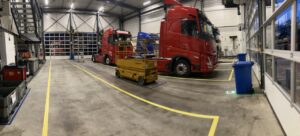
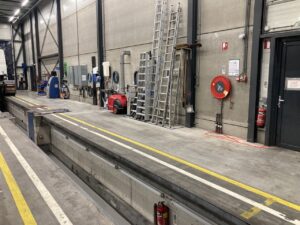
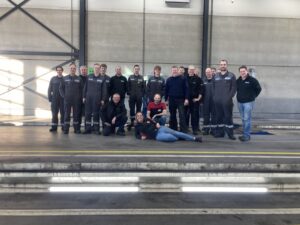
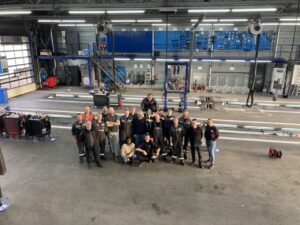
In November 2021, the Lichtenvoorde branch was the first to be rolled out. Mechanics, sales staff, and administrative employees all helped during the implementation. As a result, the rollout didn't feel like a management project, but rather like something the entire team was involved in.
“There was no one who really opposed it. I found them to be pleasant days. Putting our shoulders to the wheel and then a bite to eat and a beer. Just achieving something together,” says Jasper. Spaghetti diagrams were used to visualize the routes of mechanics. This revealed that a frequently used part had to be retrieved from the very back of the warehouse multiple times a day. By adjusting the layout, time was immediately saved, and the work process became more calm.
Jasper, who had been working at Paashuis for almost twenty years at that point, saw something happen during the rollout that he hadn't expected. “After almost twenty years at Paashuis, I've already experienced many changes. What surprised me was how quickly people contributed ideas. In the beginning, everyone mainly thought about a tidier workshop. But soon, improvement ideas came from the team, colleagues addressed each other more easily, and everyone took more responsibility for their own workspace. Then you noticed it was no longer about tidying up, but about working together differently.”
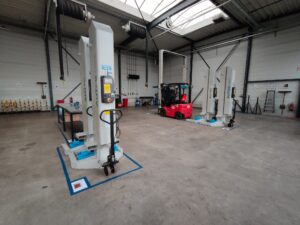
5S Implementation Paashuis Doetinchem
A week later followed the rollout in Doetinchem. Although the same methodology was applied, the starting situation was completely different. The branch had originated in 2012 from a merger of two companies. Twelve years later, different working methods and habits were still visible on the shop floor.
One of the most striking examples was a 15-meter long and 3-meter high balustrade that was completely hung with specialized tools from various brands. There were no fixed locations, no registrations, and no overview. “You just looked with your eyes. If someone needed something, they would look around until they found it. There was no system behind it. Now you look at a number, walk over, and grab it. It's become that simple,” Carlo explains.
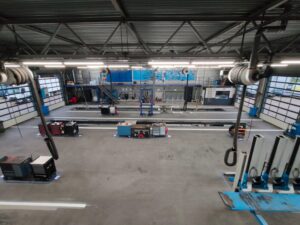
The workshop's layout was also determined together with the employees. Carlo laid a large floor plan on the table in the canteen and asked his mechanics to brainstorm the ideal layout. Initially, it was quiet. “I said, ”Guys, if you don't decide where things should go, I'll decide. And if you later say it's not convenient, you had your chance today.“ From that moment on, the conversation took off. Everyone turned out to have an opinion.” According to Carlo, that was perhaps the biggest lesson from the process. "We didn't impose anything. People were allowed to think along about the layout of their workplace. This created buy-in and changes were accepted much faster."
Why this approach works
“The most important thing to me is Dennis and Miranda's hands-on mentality. Their hands were just as dirty as our own people's. They weren't telling us how to do it from a distance, but participated themselves. That makes it much easier to get people on board,” says Carlo. Jasper recognizes that feeling immediately. “It didn't feel like something that was thought up for us, nor like an external project. It felt like something we built together.”
More than a tidy workshop
The benefits of 5S are now visible on multiple levels. “People often think of a tidy workspace when they talk about 5S. But that's not the biggest gain. Previously, we sometimes had discussions about workstations or schedules by 8:30 AM. Now, everyone knows exactly where they stand by 8 AM. That might sound small, but it leads to much more peace throughout the day. Ultimately, that might be the biggest gain. Not in a tidy workspace, but in clarity for people,” Carlo explains.
Jasper recognizes that picture. According to him, the change is not only visible on the work floor, but also in conversations with employees. “Many more things are shared within the team, which means people know better what's going on and what's expected of them. You even notice that during performance reviews. There are fewer questions, more clarity, and more involvement.” For Jasper, that is one of the biggest advantages of 5S. The extra structure not only provides clarity on the work floor, but also for more involvement within the team.
In Lichtenvoorde too, Jasper sees that employees are showing more ownership. One example that has always stuck with him is an idea from the shop floor to install a barrier at the entrance. “A week later, that proposal was still hanging there. I had already forgotten about it myself, but the system hadn't. That was a moment for me when I thought: this really works.”
Additionally, both locations notice that the appearance of the workshop influences the recruitment and retention of personnel. New employees regularly react positively to the cleanliness and structure of the work environment. The ISO 9001, ISO 14001 audit, and the Risk Inventory & Evaluation also proceeded demonstrably smoother. Even the Dutch Labour Inspectorate, during an unannounced visit to Lichtenvoorde, was pleasantly surprised by Paashuis's working methods, where safety and the prevention of accidents are well-secured.
How 5S created buy-in and pride within Paashuis
Perhaps the change within Paashuis became most apparent with owner Roger Paashuis. Where he previously focused primarily on the investment and the impact on daily operations, he saw firsthand during the rollout what was actually happening on the shop floor. Strikingly, he didn't remain on the sidelines. During both rollouts, he actively helped with tidying up, organizing, and cleaning.
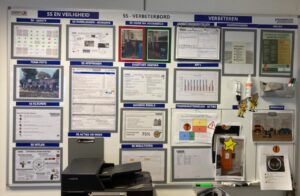
According to Jasper, that impressed the team. “When the owner is scrubbing next to you, it's hard to say it's none of your business. In the beginning, Roger really had doubts. But at a certain point, he let it 5S board see it for yourself with customers. Then you know something has changed. It wasn't due to one conversation or presentation. It was the sum of everything that happened on the work floor.” That shift reflected the change that became visible throughout the entire organization.
Bronze Lean for Retail Certification for both locations
After the rollout, the official Lean for Retail audit by Volvo Trucks followed. The result was impressive: both Lichtenvoorde and Doetinchem immediately achieved bronze certification with no demerits. “In retrospect, we told each other that we could have possibly even achieved silver,” says Jasper.
The results did not go unnoticed outside of Paashuis either. During an international meeting of Volvo Trucks, the Paashuis case was discussed as an example. Other dealers also came to see how the approach works in practice. For the team, that was confirmation that the changes were not only visible internally.
The implementation doesn't stop there. Both locations are now in the assurance phase, with 5S-Company remaining involved with support, evaluations, and periodic audits. Using the 5S improvement board and the 5S app Are improvement points kept visible and does continuous improvement remain part of daily practice?.
5S as standard operating procedure within Paashuis Bedrijfswagens
At the beginning of the process, Roger primarily described 5S as something that “costs a lot of money.” Today, he views it very differently. “I used to say that 5S cost a lot of money. Looking back, it has brought us something much more valuable: structure, ownership, and pride on the factory floor. It was worth every euro, and knowing what it has brought us, perhaps I would have done it sooner.” What started as a process from Volvo Trucks has evolved into a way of working that, according to Jasper, Carlo, and Roger, is now indispensable to the organization.
For those curious to see what that looks like in practice, Jasper says you're more than welcome at Paashuis Lichtenvoorde. “We're happy to show what it has brought us.”
About Paashuis Commercial Vehicles
Paashuis Bedrijfswagens is a dealer of Volvo Trucks, Renault Trucks, and Renault commercial vehicles for the Achterhoek and East Gelderland regions. They offer a comprehensive concept where, in addition to the product, their service concepts also play a significant role. Whether it's diesel-powered, electric, or LNG, they ensure they configure the best vehicle for the work it will be used for.
COMPANY: Paashuis Commercial Vehicles (Lichtenvoorde and Doetinchem)
OVER TO YOU: Roger Paashuis (Owner), Jasper te Braak (Manager), Carlo Scheerder (Manager)